Εμφάνιση αναρτήσεων με ετικέτα history. Εμφάνιση όλων των αναρτήσεων

Σάββατο 14 Δεκεμβρίου 2013

Catching up with the violin making process


Hello everyone, I know that it's been a while since my last post but we are here now to smouthly continue our journey.

When you think about the process of bulding a new instrument, it may appear to be a linear process, but in reality this is much more like art than it is like carpentry. The wood needs to be worked, glued, shaved, and modeled before it is made into something new and beautiful.

The violin maker takes a block of wood which is created by cutting a radial slice of the huge maple and spruce trees used for this purpose. Then he takes those slices and cuts them to two thinner slices, these are opened like two pages of a book and need to be glued together back to back in the most exact manner.


 And this is the part where the Center Joint, which is the line that glues together both parts of an instrument's front or back, is created. To that end, each of the sides needs to be planed and shaved until they fit each other perfectly, with not a crack or a hair of air between them.

Let me tell you that it is a serious challenge for violin makers and it takes many hours and many many wood shavings in order to reach that exact pairing of the two sides.


So, all the work begins when the violin maker is working on the "roughing" form of the fronts and backs of the instrument. Carving the wood is the most physical part of the entire process and that is usually just for a single instrument!

As you can see in the pictures below, this is extremely hard, as the violin maker has to put all his weight in order to push through the maple and spruce wood. The shavings are indeed very rough at the beginning of the process, but in time they become smaller and more curved. And finally, when the general shape of the external arch is reached and the surface needs to be smoothened, they become thinner and thinner until they reach the desirable result.


The shavings that fall off the wood are beautiful. They are thin, curved and look like waves,snails or even curls, and they give off the most wonderful wooden smell.


Τρίτη 15 Οκτωβρίου 2013

A few things about a violin

The first step on building a new violin is naturally to get to know the subject of your work . Since the Baroque era, the violin has been one of the most important of all instruments in classical music, for many reasons . Such as, the tone of a violin, which stands out above other instruments, making it appropriate for playing a melody line . And of course the fact that violins make up a large part of an orchestra.

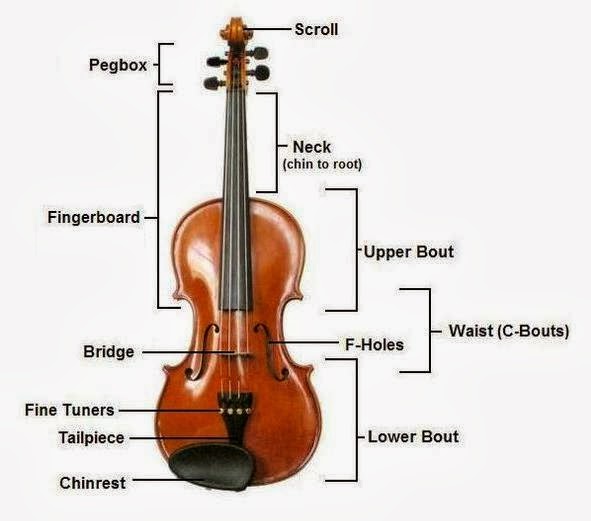
So, to begin with, it must be said that a violin generally consists of a spruse top, maple ribs and back, two endblocks, a neck, a bridge, a soundpost, fur strings, and various fittings . The voice of a violin depends on its shape, the wood it is made from and the varnish, it goes without saying, that the varnish and especially the wood continue to improve with age.


We must emphasize that in the amazing world of violin making, each model has its own uniqueness . This is due, partially, to the fact that constructing a hand-made string instrument is one of the most painstaking, exact, minute-detailed jobs i have ever come across .
Certainly not all violins in the market are hand-build and perhaps most of them are not. Many violins are serially made, either in factories or in mass-production workshops . And honestly that is the reason why a handmade violin has a precious value . The singularity of each handmade violin can satisfy even the most demanding collector and of course any worthwhile violinist who respects the intensive labor and the enormous amount of patience that is required to succeed this outcome .